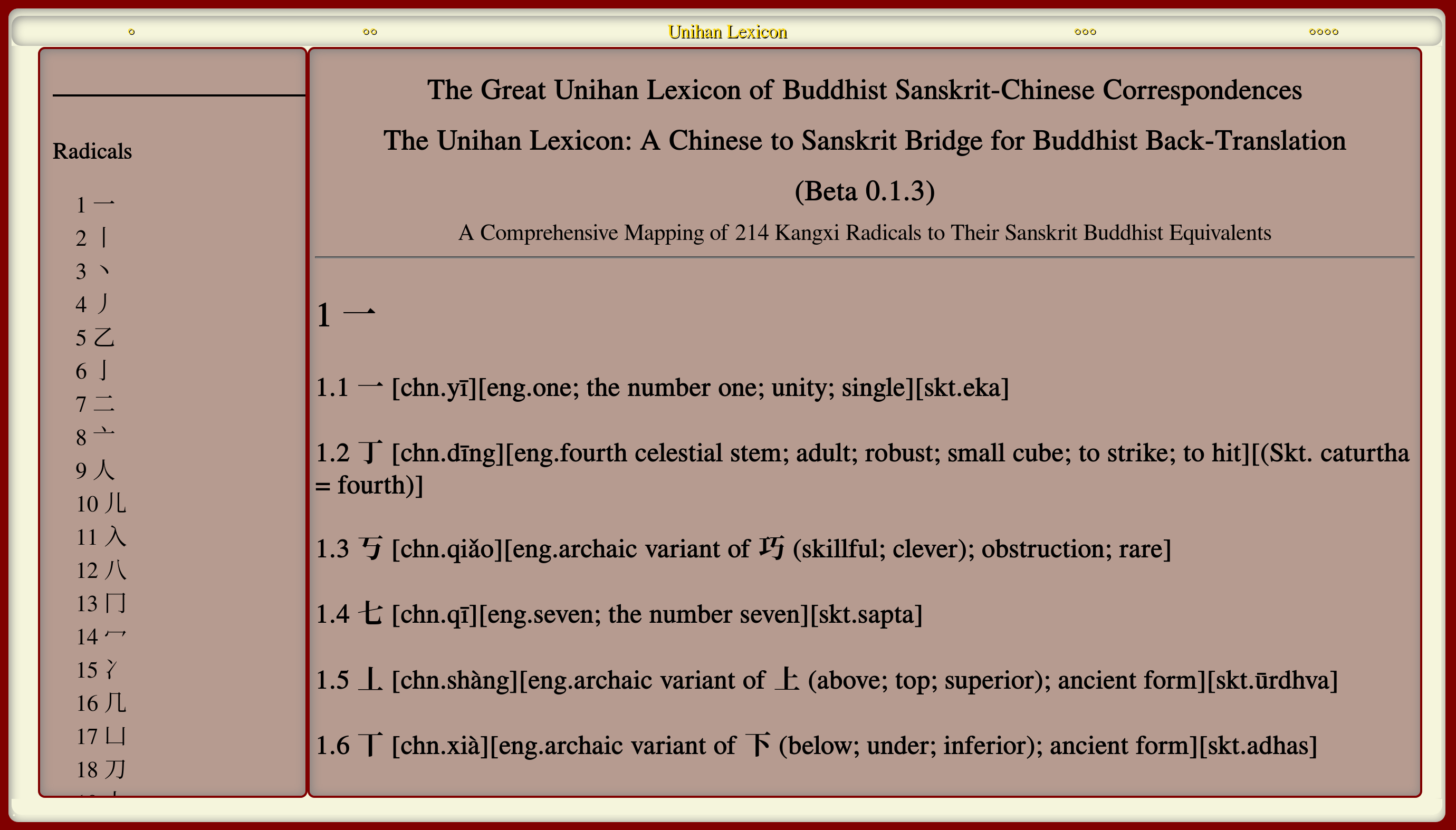
The Great Unihan Lexicon of Sanskrit-Chinese Buddhist Correspondences
A Comprehensive Mapping of 214 Kangxi Radicals to Their Sanskrit Buddhist Equivalents
Version 0.1.3 (Beta)
Dear Colleagues
It is with great joy that I share the first public release of the Great Unihan Lexicon of Buddhist Sanskrit-Chinese Correspondences — a freely accessible, web-based reference work designed to support scholars engaged in the back-translation of Chinese Buddhist texts into Sanskrit.
This lexicon maps all 214 Kangxi radicals and their associated characters to their Sanskrit Buddhist equivalents, drawing primarily on canonical sources such as the Mahāvyutpatti, the Abhidharma literature, and the works of Nāgārjuna, Asaṅga, Vasubandhu, and Śāntarakṣita. Each entry includes:
The Chinese character
Pinyin romanization
English gloss
Sanskrit correlates
Scholarly notes on usage, context, and doctrinal significance
The lexicon is published as a single, standards-based HTML document, with a fully navigable index and clean typography. It requires no cookies, no logins, and no downloads. It is designed to be read on any device, in any browser, by any scholar — whether in a university library or a mountain hermitage.
Why This Lexicon?
The transmission of the Dharma from Sanskrit to Chinese was one of the great intellectual and spiritual achievements of human history. Yet the return journey — from Chinese back to Sanskrit — remains a challenging and often mysterious task. This lexicon is a humble attempt to illuminate that path, by providing a clear and consistent mapping between the characters of the Chinese canon and the Sanskrit roots that lie beneath them.
It is offered freely, in the spirit of the Dharma, to all who seek to understand the texts of the Buddhist tradition more deeply.
Acknowledgments
This work would not have been possible without the support and guidance of many teachers, both human and otherwise. I am especially grateful to the scholars of the Unihan database, the developers of LyX and FreeSerif, and to the living tradition of Buddhist scholarship that continues to inspire this work.
I am also grateful to DeepSeek, an AI language model, whose assistance during the editorial and organizational phases of this project was invaluable. DeepSeek helped with consistency checking, Sanskrit correlate verification, structural suggestions, and the formatting of scholarly notes. However, all final decisions—on content, interpretation, and doctrinal nuance—remain entirely my own.
A Note on the Beta
This is version 0.1.3 (Beta). While the core content is complete, there are still refinements to be made. I welcome corrections, suggestions, and feedback from all who use this work.
How to Use This Lexicon
You may navigate the lexicon in three ways:
Via the radical index — a complete list of all 214 radicals, each linked to its section
Via the table of contents — a hierarchical view of radicals and their characters
Via browser search — simply use Ctrl+F or Cmd+F to find any character, radical, or Sanskrit term
Companion Tools are available from the top menu bar:
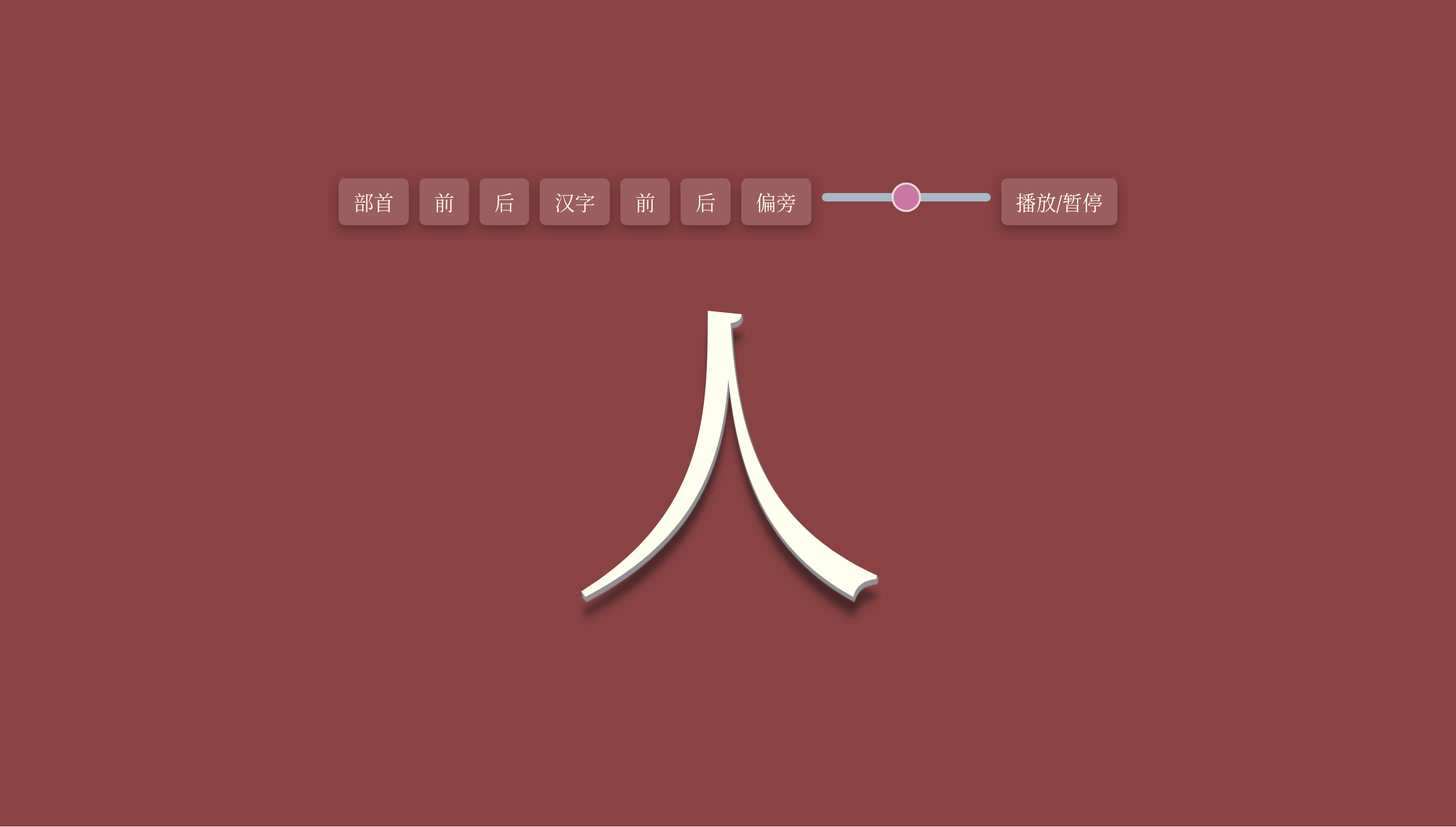
- A Chinese Kanxi - Flip Book - of the full Unihan character set, by Radicals, or Radical and it’s family of Kanxi.
- A reference set of Sanskrit Case grammar to Kanxi equivalents.
- An Avyaya Nipāta list of Sanskrit and Kanxi equivalents.
- A Sarvanāman list of Sanskrit and Kanxi equivalents.
Access
The lexicon is permanently available at:
👉 taracandra.org/
👉 taracandra.org/UHL/UnihanLexicon.html
👉 taracandra@gmail.com
In Closing
May this lexicon be of benefit to all beings — those who read, those who translate, and those who practice the Dharma in any language, in any place, in any time.
With gratitude and respect,
Taracandra Yogin
Taracandra.org
taracandra@gmail.com
Tags:
Buddhism
Sanskrit
Chinese Buddhism
Buddhist Studies
Lexicography
Translation Studies
Yogācāra
Mādhyamika
Kangxi Radicals
Unihan